Host: receive bookings
Other operators sell your homes. Your team manages the stay.
Start the Host setupThe ask was simple: turn on Host with two or three operators you trust. These are the working materials behind that ask — what to settle first, what the setup actually involves, and what to do after it is on.
Other operators sell your homes. Your team manages the stay.
Start the Host setupSell partner homes through your brand, then introduce the guest to their Host.
Start the Agent setupRead it here, or print this page and take it into the conversation.
Shared experience, not professional advice. Adapt these materials to your business and confirm current terms with Streamline.
These materials are shared as one operator’s experience, and nothing on this page is legal, tax, accounting, or financial advice. Alex Zemianek is not your attorney, your broker, or your advisor, and reading this page does not create any of those relationships.
Every template here is a starting point to be revised, not a document to use as written. Any agreement between operators should be drafted or reviewed by your own attorney, and your own accountant should confirm how the money moves before it moves.
Commission structures, program terms, and platform behaviour change, and they differ by agreement and by market. Confirm current terms with Streamline directly rather than relying on anything described here. Any figures shown are illustrative unless explicitly stated otherwise, and are not a projection of what your business will do.
Six things to settle with a partner operator before anyone changes a setting. None of them are hard, and all of them are painful to work out after a guest is already in the house.
What percentage, on what base, and who calculates it. Agree on whether the number applies to room rate only or to the full booking value, and write down one worked example both sides sign off on.
Who takes the guest payment and whose processor it runs through. This decides who carries chargeback exposure, so it is not an accounting detail — settle it first.
When the invoice is raised, when it is paid, and what happens to a stay that crosses a month end. Pick a day of the month and put it in writing.
Who the guest hears from, at what point, and under whose brand. Decide who answers the phone at 11pm before you need the answer at 11pm.
Whose cancellation policy governs, who issues the refund, and how commission is unwound when a stay cancels after it was invoiced.
Who responds, who supplies the evidence, and who absorbs the loss if the dispute is lost. This is the item most often skipped and the one most likely to end a partnership.
Have your own attorney review it before you sign anything.
Host means you receive bookings — other operators sell your homes. Agent is the other direction: you create and list, and give bookings to operators whose homes you sell. Most operators should start with Host.
Start with two or three you already know. This is a peer booking network, so the trust question comes before the technical one.
A settings change inside Streamline. Your existing rates, calendars, and restrictions keep working the way they already do.
The guest payment still runs through you. Confirm this matches whatever you agreed on the one-pager above.
Same cleaners, same standards, same messaging. Nothing about how you operate changes.
That is the whole return on the setting — demand from a market you were not selling into.
You keep the guest, the money, and the standard.
The questions below are the ones worth answering in advance. They are deliberately written as questions rather than answers — the right answer depends on your agreement, your processor, and your accountant.
Program layers and agent commission percentages quoted in the session were illustrative and used to show the shape of the math, not the terms of any specific agreement. Confirm current terms with Streamline.
The booking triggers one dual-branded introduction from the Agent to the guest. It connects the brand the guest booked through with the Host who will manage their stay, so the guest knows who is looking after them and where to go for help.
Through the Agent’s brand.
One dual-branded message to the guest.
Arrival details and ongoing guest support.
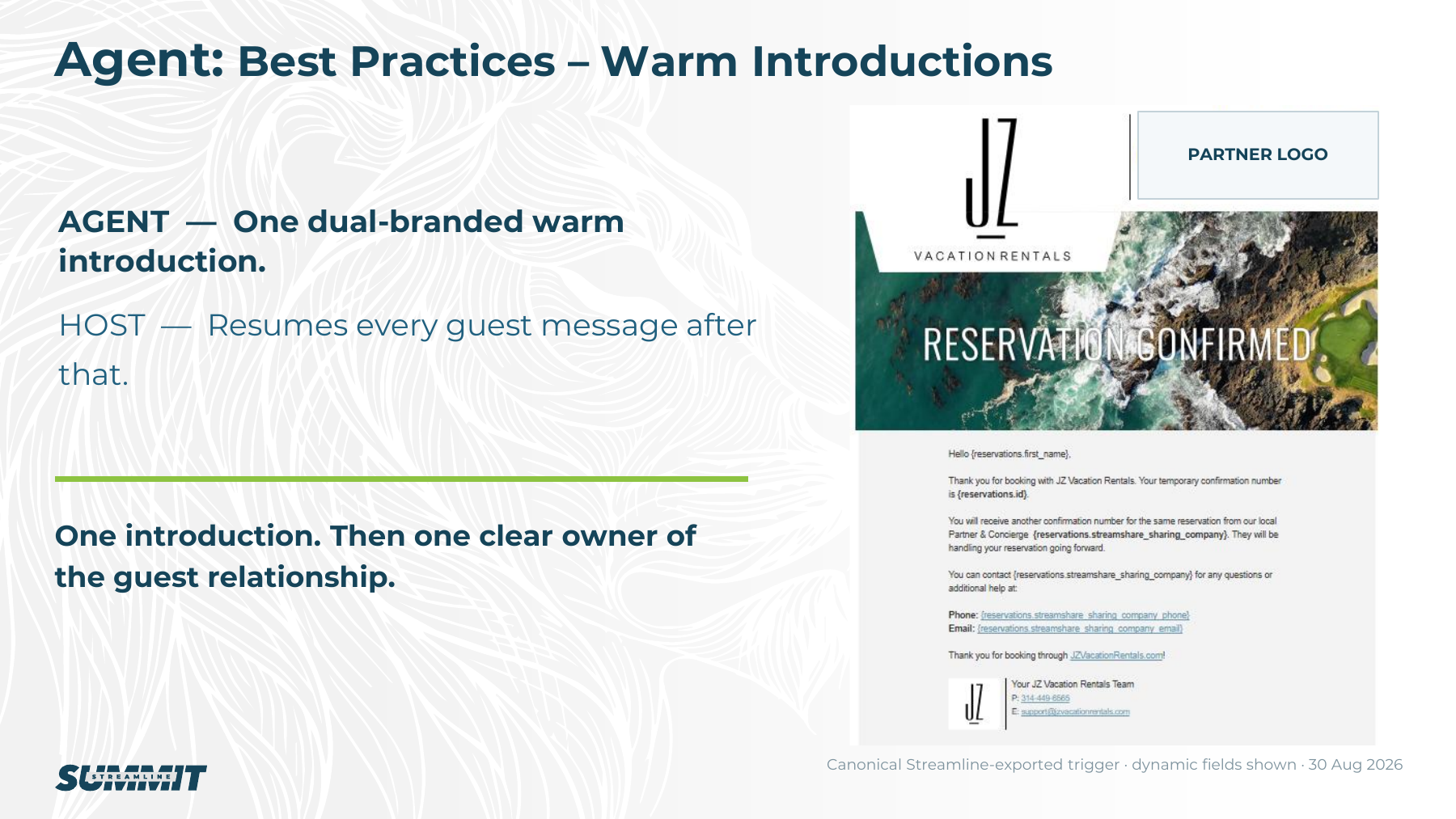
The sample uses the Agent’s logo alongside a generic partner logo. The reservation fields below are shown as they appear in the example.
Reservation confirmed

Hello {reservations.first_name},

Thank you for booking with JZ Vacation Rentals. Your temporary confirmation number is {reservations.id}.

You will receive another confirmation number for the same reservation from our local Partner & Concierge {reservations.streamshare_sharing_company}. They will be handling your reservation going forward.

You can contact {reservations.streamshare_sharing_company} for any questions or additional help at:

Phone: {reservations.streamshare_sharing_company_phone}
Email: {reservations.streamshare_sharing_company_email}

Thank you for booking through JZVacationRentals.com!

Your JZ Vacation Rentals Team
P: 314-449-8655
E: support@jzvacationrentals.comThank the guest for booking, introduce the Host managing the property, and explain who will send arrival information and help during the stay. After this introduction, the Host owns subsequent guest messages.
Host is a setting. Selling other operators’ homes is a strategy, and it is the half that takes real work. This is the loop, and the discipline is in step four.
One. The temptation is to switch everything on at once, and it is the reason most operators get nothing out of it. Choose a market where you could genuinely answer an owner question.
Inventory volume is not the product. A tight, well-photographed, accurately-described set of homes is worth more than everything you could possibly list.
Verify the market pages, watch which ones get indexed, and read the queries that actually reach you. Ninety days is roughly when the picture becomes readable — it is a measurement window, not a promise about results.
Add the second market once the first one is producing and you know why. Repeating a loop you have not measured is just doing it twice.
Search visibility depends on many factors outside any one program. Nothing here promises rankings, indexation, or bookings — the ninety days is a measurement window, so that you find out whether it is working before you scale it.
Agent means you create demand: you market and list other operators’ homes into demand you build, in markets you don’t manage. It is an investment in marketing, content and website growth, and the setup runs through your website provider before it runs through Streamline.
StreamShare inventory is delivered through your website provider, and the StreamShare APIs are open to third-party website providers. Before you opt in, ask yours how partner homes will render, index, and be tracked on your site.
Agent is a program setting the same way Host is. Turn it on only once the website side is answered, so the first partner home that appears on your site appears the way you want it to.
You are putting another operator’s homes under your brand. Pick operators whose standards, photography, and guest handling you would be comfortable defending to your own guest.
As presented at the Summit, Streamline invoices a program fee on room rent for StreamShare stays (3% was the figure shown). Two ways to carry it: build it into the StreamShare rate type, or create a StreamShare-specific fee. Confirm current terms with Streamline before you rely on either number.
When the guest books through the Agent, send one dual-branded introduction to the guest. Connect the brand they booked through with the Host managing their stay, and identify the Host as their contact for arrival details and guest support. After this introduction, the Host owns subsequent guest messages.
Program fees and commission percentages shown in the session were the figures presented on the day and are not contract terms. Confirm current terms with Streamline before you set a rate type or a fee around them.
Three different questions a traveller asks, three different things to do about it. Each column ends with how you would know it is working, because that is a measurement you can take, not a result anyone can promise you.
Someone types “cabins near Lake Tahoe” into Google.
How you’d know: Search Console shows city searches landing on those pages.
Someone asks “is there parking?” and reads the answer without clicking.
How you’d know: Your own wording comes back in the answer box.
Someone asks an AI to pick a place to stay in your town.
How you’d know: Ask the AI yourself and see whether it names you.
A backlink is another website linking to yours. Search engines and AI read it as somebody vouching for you. Work outward in this order.
Search visibility depends on many factors outside any one program or link. None of this promises rankings, citations, or bookings.
StreamShare Operator Exchange
A private community for Streamline customers using or exploring StreamShare. Meet fellow operators, compare practical lessons, and find potential partners.
Organized independently by Alex Zemianek. This is a peer community, not an official Streamline support channel. Membership will be reviewed before invitations are sent.
Help shape what comes next. Leave your details and Alex will contact you when the community is ready.
Happy to walk through how we set ours up, what we got wrong first, and what we would do differently. No pitch attached.